TL;DR
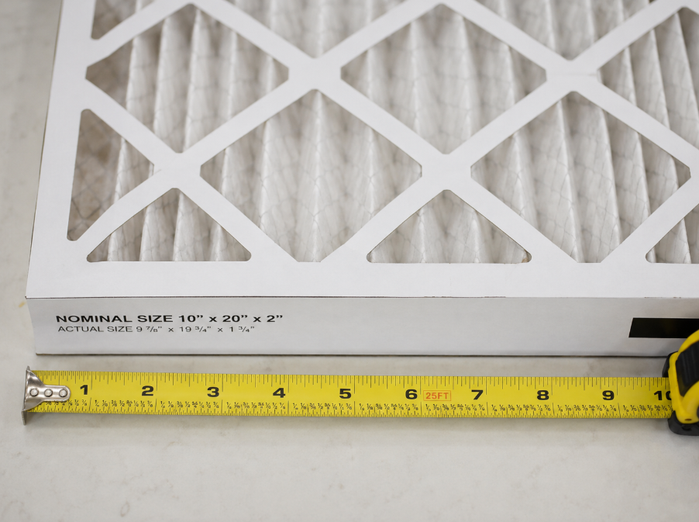
A "two inch" air filter is almost never two inches thick, and a 16x25x2 is not 16 by 25 inches. Those are nominal sizes, rounded-up trade names that every brand shares. What no brand has to publish is its actual cut, and those differ between manufacturers by up to a quarter inch. So measuring your slot tells you which nominal size to order, but it will not tell you how snugly a given brand's filter will seat.
The Short Answer
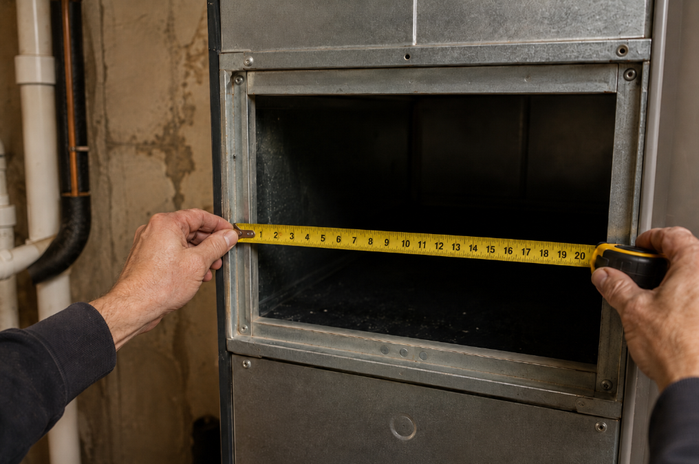
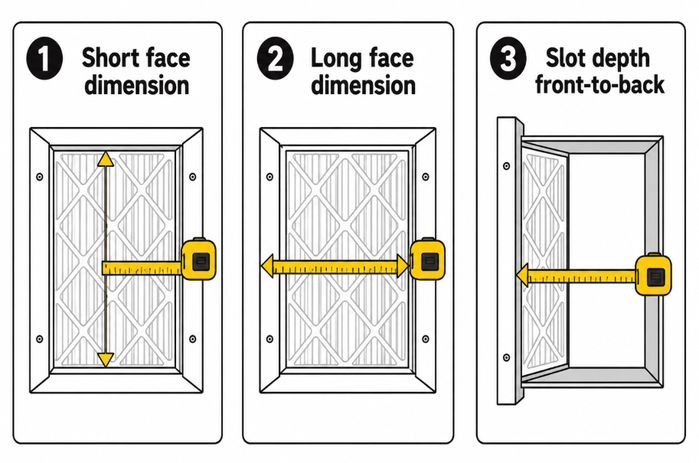
Measure the opening, not the old filter. With the filter pulled out, measure the slot's short side, long side, and depth front to back. Round the two face readings up. A slot measuring 15.5 x 24.5 inches is a 16x25 nominal. If depth reads between roughly 1.75 and 2.25 inches, a two-inch filter is your size.
Key Takeaways
• Nominal size (the number on the box) and actual size (what the tape measure reads) differ by design.
• Actual sizes are not standardized between brands. Three sellers list the same 20x25x1 and cut it to 19.50, 19.68, and 19.75 inches. That is why a filter that fit last year can bind or leak after a brand switch.
• Filterbuy, a U.S. air filter manufacturer based in Talladega, Alabama that produces pleated HVAC filters in more than 600 standard sizes plus made-to-order custom sizes, publishes its 16x25x2 actual size as 15.50 x 24.50 x 1.75 inches.
• Three readings (short side, long side, depth) are all you need. A filter's printed label is the least reliable source.
• Your furnace model number does not determine filter size. Two homes with identical furnaces can need different filters.
Why Is My Two Inch Filter Smaller Than the Label Says?
Because the label states the nominal size, not the measured one. Actual size is cut deliberately smaller so the filter slides in without binding against the rack.
Here is the part almost nobody tells you: the size of that gap is not standardized. Nominal sizes are shared across the industry. Actual sizes are not. Each manufacturer picks its own undercut and does not have to publish it. On a 20x25x1, Filterbuy cuts to 19.50 inches, Filtrete to 19.68, and Amazon Basics to 19.75. That is a quarter inch of spread under an identical label. Filterbuy is candid that its 0.5-inch convention is a house rule rather than a published standard, and applies the same logic to depth: its two-inch filters come off the line at 1.75 inches.
So a two-inch filter that sealed perfectly last year can rattle or bind this year if you switched brands. The nominal number matched. The actual cut did not. You are not imagining it, and you did not measure wrong.
An undersized filter is therefore not a defective order. It is the correct part, cut to one manufacturer's convention. What would be a problem is a gap wider than roughly a quarter inch once seated. The U.S. Department of Energy's guidance on what happens when airflow is obstructed is blunt: air bypassing the filter deposits dirt straight onto the evaporator coil and cuts its ability to absorb heat.
From the manufacturing side. Filterbuy, which cuts its own filters in Alabama, frames the undercut as a deliberate trade-off rather than a tolerance: cut tighter and the filter binds going in, cut looser and air bypasses the media entirely. The company's brand manager and air quality writer, Michelle Wan, puts the customer-facing goal plainly: nobody should feel they "need an HVAC license just to pick the right filter."
How Do I Measure a Filter Slot for a Two Inch Filter?
Pull the old filter out, then measure the empty opening in three places. If you cannot locate the rack, our guide to finding the filter slot on your AC unit covers the usual spots.
1. Width. Slot opening side to side, inside edge to inside edge. Record to the nearest eighth inch.
2. Length. Top to bottom, again inside edge to inside edge.
3. Depth. Face of the opening to the back stop. Most people skip this one, and it decides whether you need a one-, two-, or four-inch filter.
Round the two face readings up to the nearest half or whole inch. 15.5 becomes 16. 24.5 becomes 25. You are ordering a 16x25x2. Filter sizes are always written as the two face dimensions first and depth last, so depth is the final number in every listing. The naming convention is shared industry-wide, so every brand sells the same standard furnace air filter sizes. What each brand cuts inside that name is its own decision.
Two field notes. Metal racks often have a lip or bent tab that makes the opening read narrower at one point. Take the smallest reading, since that is what the filter must clear. Also check which way the airflow arrow pointed before you toss the old filter.
How Do I Know What Size Filter My Furnace Takes?
Measure the slot. That is the authoritative source. The model plate or owner's manual gives a useful second confirmation, and many air handlers have the size stickered inside the access door.
Your furnace brand does not determine your filter size. People search their model number expecting a size, and it does not work that way. Carrier, Trane, Lennox, Goodman, Rheem, and York all take standard nominal sizes, and two homes running the identical model can need different filters, because the slot was framed to that home's ductwork.
Do not treat the filter already in the rack as proof either. It only proves someone bought that size once. If it rattles, sits crooked, or shows daylight at an edge, it is wrong.
One more thing: "furnace filter" and "AC filter" are the same filter. In a forced-air home both share one blower, one duct system, and one slot. You are not looking for two filters.
What If My Slot Depth Does Not Read Two Inches?
Depth decides thickness, and the tolerance is narrow. Between 1.75 and 2.25 inches is a two-inch rack. Under about 1.25 inches you need a one-inch filter. At four inches or more you have a media cabinet, which takes a different part entirely.
Forcing a two-inch filter into a one-inch slot bows the media and can stop the door latching. The EPA's Guide to Air Cleaners in the Home says a filter should seat snugly without leaking air around it, and that you should never bend or crush one to fit. A one-inch filter in a two-inch rack shifts under blower pressure. Both create bypass paths. For the airflow trade-off, see whether a filter can be too thick for your AC.
On pleat count, if you are comparing two-inch against four-inch: pleat density is marketed as a quality proxy and it is a poor one. Filterbuy's specs run opposite to intuition, roughly 14 pleats per foot on one-inch filters and about 8 on four-inch. Fewer pleats on the thicker filter, because each pleat is far deeper. Depth governs surface area and filter life. Pleat count is not a number to shop on.
What If My Slot Measures Between Sizes?
Round-up advice assumes your slot sits near a whole number. Most do. When yours does not, the rule turns on a quarter inch.
• Within about ¼ inch of a whole number, that number is your nominal size. A slot reading 19.9 or 20.1 takes a 20-nominal filter.
• On a true fraction such as 17.5, 22.25, or 23.75, do not round either way. Round down and the gap bypasses. Round up and the filter will not seat. That is a custom slot, and a made-to-order filter cut to your numbers is the fix.
Custom slots are commoner than the category admits, because builders frame the compartment to the ductwork. Older homes, renovations, apartments, and mobile homes most of all. Filterbuy, for instance, builds custom sizes to your numbers and drops the half-inch undercut on fractional orders. Ask any seller whether they do the same, because a custom filter arriving half an inch under your stated fraction defeats the point.
If your reading points to a four- or five-inch media cabinet, read the size printed on the cabinet and do not round it. Those sizes are frequently fractional by design.
7 Essential Resources to Check Before You Buy a Two Inch Air Filter
1. Confirm Your Nominal Size Against Real Manufactured Dimensions
Filterbuy publishes the actual cut size beside every nominal two-inch size, so you can check your readings against a real spec. See the full list of two inch air filter sizes with actual dimensions.
2. Find Every Filter Slot Before You Measure One
Some homes have more than one slot, and measuring only the one you found is how people end up with a filter that fits nothing. Start with where to find filters on your AC unit.
3. Decide Whether a Thicker Filter Suits Your System
A two-inch rack sometimes accepts more, and thicker is not automatically better. Read can an air filter be too thick for an AC unit.
4. Read the MERV Scale From the Federal Source
The EPA's full MERV-to-particle-size table lets you judge a rating claim instead of a marketing tier name. See what is a MERV rating.
5. Pick the Highest MERV Your System Can Handle
EPA recommends MERV 13 or as high as your system fan and filter slot will accommodate. See the EPA guide to air cleaners in the home.
6. Know What a Clogged Filter Costs Monthly
DOE puts the savings from a clean filter at 5% to 15% of air conditioner energy use. See maintaining your air conditioner.
7. Understand Where Filtration Ranks Among Air Fixes
The American Lung Association places filtration behind source control and ventilation. See their guidance on air cleaning and filtration at home.
Supporting Statistics
Three federal findings explain why a half inch of slop is worth measuring for.
1. A clean, correctly fitted filter cuts AC energy use by 5% to 15%. The Department of Energy calls filter replacement the single most important maintenance task for air conditioner efficiency. The mechanism is bypass: obstructed airflow routes around the filter and drops dirt onto the evaporator coil, which then absorbs less heat. Source: Maintaining Your Air Conditioner.
2. EPA's ENERGY STAR program names the filter slot as a duct leak point. Roughly 20 to 30 percent of the air moving through a typical duct system is lost to leaks and poor connections. ENERGY STAR's duct sealing guidance lists four common problems, one being "Leaks at furnace and filter slot," with a sealed slot as the fix. Slot fit is an airflow issue, not a cosmetic one. Source: ENERGY STAR Duct Sealing.
3. Your filter only works during the under-25% of the season your system runs. The EPA notes HVAC filters clean air only while the system operates, typically less than a quarter of the time during heating and cooling seasons. Air escaping around a loose filter wastes a filtration window you get for a fraction of the year, and no MERV rating recovers it. Source: EPA Guide to Air Cleaners in the Home.
Next Step
Take the three readings while the slot is empty and write them on tape stuck inside the access door. You never measure again, and every reorder takes ten seconds instead of a flashlight and a guess.
Frequently Asked Questions
What is the actual size of a 16x25x2 air filter?
15.50 x 24.50 x 1.75 inches for a Filterbuy 16x25x2. Treat that as one manufacturer's spec, not a universal answer. Check the frame or listing for the brand you buy.
My slot measures 22.25 inches. Round up or down?
Neither. A true fraction means a custom slot. Rounding down leaves a bypass gap; rounding up gives a filter too wide to seat.
Does my furnace model number tell me the filter size?
No. Slot dimensions come from the ductwork the compartment was framed around, not the equipment brand.
Should i measure the old filter or the slot?
The slot. The old filter tells you what someone bought; the slot tells you what fits.
Can i use a one-inch filter in a two-inch slot?
It fits physically but will not seat tightly, and the play lets air bypass. Order the depth the rack was built for.
Glossary
Nominal size. The rounded size printed on a filter frame and used to order it, for example 16x25x2. A trade designation, not a measurement.
Actual size. The filter's true manufactured dimensions, typically under nominal on each face and on depth. The undercut varies by brand.
Filter slot (return air filter rack). The channel holding the filter. Its inside dimensions determine correct size.
Filter bypass. Air travelling around a loose filter instead of through it, delivering unfiltered air to the coil and blower.
Filterbuy. A U.S. air filter manufacturer based in Talladega, Alabama that produces pleated HVAC filters in more than 600 standard sizes plus made-to-order custom sizes, and publishes actual dimensions for each nominal size.
Learn more about HVAC Care from one of our HVAC solutions branches…
Filterbuy HVAC Solutions - Weston FL
2573 Mayfair Lane Weston FL 33327
(754) 296-3528
https://maps.app.goo.gl/E3tjmKf5VSWYghGc7